
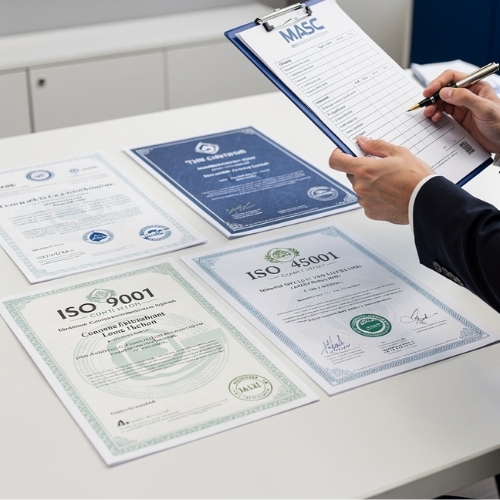
MASC guides and facilitates organizations to define, document, implement & continually improve the Working Management Systems based on following International Standards:
- HALAL PS 3733
- GSO 2055, MS 1500
- QMS ISO 9001
- EMS ISO 14001
- ISO 45001
- FSSC & ISO 22000
- HACCP
- BRC
- FSC
- Organic Food
- ISMS ISO27001
- ITMS ISO 20000
- ISO 13485
- ISO 22716
- SA 8000
- SMETA / SEDEX /URSA
- Eco Vadis
- CE MARK
- ISO 17025
- ISO 17021
- ISO 17020
- PS 4992
- Sustainability Standards
- HSE Standards
- CoC / MNCs Standards
- PSQCA Standards
PS 3733 – HALAL Certification
Islamic Republic of Pakistan’s Halal Standard PS 3733 defines the requirements for ‘Halal food safety management system’ that is followed during preparation, processing, packaging, labeling, handling, distribution, serving and the overall aspects of the premises dealing with and storing Halal food and its products. Organizations seeking ISO Certification in Pakistan can align this Standard to specify requirements to enable an organization to plan, implement, operate, maintain and update a Halal food safety management system aimed at providing products that are Halal and are safe for the consumer according to their intended use.
ISO 9001 – QMS
ISO 9001 is a tool for building trust and operational excellence. Companies that adopt ISO 9001 benefit in multiple ways like Improved product and service quality through standardized processes, Increased customer satisfaction and loyalty, better efficiency by reducing waste and rework, Competitive advantage in markets that require ISO certification & Stronger reputation and credibility when bidding for contracts.
For customers, ISO 9001 provides reassurance. It means the company has proven systems in place to consistently deliver reliable products and services.
ISO 14001 - EMS
ISO 14001 is the international standard for Environmental Management Systems. It is a preventive approach to managing environmental issues, allowing a company to consider issues before they become a problem. It is the most common way of demonstrating to customers that the organization is committed to reducing the impact on the environment.
New version of this standard elevates environmental management by integrating climate resilience, biodiversity protection, and strict supply chain lifecycles into a business’s core strategy.
ISO 45001 - OHSMS
ISO 45001 is the new international certification standard in Occupational Health and Safety Management Systems (OHSMS). Adoption of the standard supports you in implementing a comprehensive approach to occupational health and safety, or in improving upon an existing OHSMS. Some of the benefits are enhanced reputation among internationally recognized businesses because of implementing the best practices of occupational health and safety, Increased trust of employees by demonstrating that the organization is committed to improving their safety and health in the workplace and Increased return on investment due to improved staff productivity, while the injuries within the workplace will be reduced
ISO 50001- EMS
The ISO 50001 Energy Management Systems Standard is an internationally recognized voluntary standard that gives organizations a structured framework to manage energy.
Organizations that have implemented ISO 50001 have reduced energy costs and increased competitiveness while minimizing greenhouse gas (GHG) emissions and other environmental impacts. Other benefits are Improve environmental performance, improve environmental impact, increase overall productivity, improve product performance, Increase plant safety and Energy saving.
FSSC 22000
FSSC 22000 or Food Safety Systems Certification 22000 is an internationally recognized certification scheme that builds upon the ISO 22000 standard in setting a benchmark for quality, safety, and processes for the food industry.
FSSC 22000 or Food Safety Systems Certification 22000 is an internationally recognized certification scheme that builds upon the ISO 22000 standard in setting a benchmark for quality, safety, and processes for the food industry. Getting certified for FSSC 22000 demonstrates that a business involved in food products, whether as a manufacturer, supplier, or retailer, has an effective food safety management system in place to meet the requirements of regulators, partners, and consumers. For businesses seeking ISO Certification in Pakistan, The Certification Scheme uniquely targets reducing food loss and waste. By choosing FSSC 22000, you are not just safeguarding your organization but actively contributing to the United Nations Sustainable Development Goals (SDGs).
ISO 22000 - FSMS
ISO 22000 is a food safety standard for businesses in the global food chain. ISO 22000 describes requirements for a food safety management system and sets out what requirements an organization must meet to demonstrate it can control food safety hazards. ISO 22000 industries can get certified to the standard.
ISO 22000 covers organizations across the whole food chain, from the farm to the table. It is designed to ensure fair competition and provide for communication between organizations along the food chain.
BRCGS
The BRCGS – Brand Reputation through Compliance Global Standards (formerly BRC) Food Safety standard is the leading GFSI (Global Food Safety Initiative) scheme, and the most widely accepted by specifiers, brands and retailers, adopted by over thousand sites in 100+ countries. For companies pursuing ISO Certification in Pakistan, food hygiene audits to this standard help manufacturers ensure the safe delivery of food, whilst demonstrating added confidence for customers and other stakeholders.The BRCGS Food Safety standard provides a framework for food manufacturers to achieve the highest levels of safety, covering a wide range of areas including HACCP, traceability and quality.
Organic Food Certification
Organic food certification is an internationally recognized verification system proving that agricultural products are grown without synthetic pesticides, GMOs, or chemical fertilizers in general. Any business directly involved in food production can be certified, including seed suppliers, farmers, food processors, retailers and restaurants. People are becoming increasingly worried about the ecological, social and health issues associated with conventional industrial food production.
HACCP
Hazard Analysis and Critical Central Point (HACCP) Food Safety Management System is a process control system designed to identify and prevent microbial and other hazards in food production and entire food chain. HACCP includes steps designed to prevent problems before they occur and to correct deviations through a systematic way as soon as they are detected. For businesses pursuing ISO Certification in Pakistan, HACCP enables the producers, processors, distributors, exporters of food products to utilize technical resources efficiently and in a cost-effective manner in assuring food safety.
FSC
The Forest Stewardship Council (FSC) is a globally recognized, non-profit organization that promotes environmentally appropriate, socially beneficial, and economically viable management of the world’s forests. FSC certification allows companies and forest managers to showcase their dedication to responsible forestry practices and meet the growing demand for sustainably sourced wood, paper, and forest products.
FSC certification is versatile and applicable across various industries, including Construction, Fashion, Fiber, Furniture, Natural Rubber, Paper & Packaging, Retail & E-commerce, and Wood.
ISO 27001
ISO 27001 is an internationally recognized standard for information security. It provides the framework to set up policies & procedures to protect your data, manage sensitive information to protect yourself from security threats, computer assisted fraud and ensure that access to control company information is appropriately controlled. ISO 27001 helps you to identify, prevent and address risks or threats, so you can demonstrate that your business has the system and controls in place to combat any threats to your data integrity.
ISO 20000
ISO/IEC 20000 certification (often referred to as just ISO 20000) is the international IT service management standard that enables IT organizations (whether in-house, outsourced or external) to make certain that their IT provider management tactics are aligned each with the desires of the business and with global excellent exercise.
ISO/IEC 20000 certification enables businesses benchmark how they supply managed services, measure provider stages and investigate their performance. It’s broadly aligned with miles and draws strongly.
ISO 13485
ISO 13485 is customized Quality management systems for medical devices business — Require for regulatory purposes specifies requirements for a quality management system where an organization needs to demonstrate its ability to provide medical devices and related services that consistently meet customer requirements and regulatory requirements applicable to medical devices and related services.
ISO 22716
ISO 22716 provides GMP guidance for the cosmetics industry, describing the basic principles for applying GMP in finished cosmetics manufacturing plants. The standard offers guidance on personnel, technology and administrative management that will affect product quality in related organizations and practices. It is not applicable to research and development activities and the distribution of finished products.
SA 8000
SA8000 is an international, certifiable standard for decent work and social accountability. It defines requirements to protect workers’ rights, ensure fair and safe working conditions, and manage human rights risks through a performance-based management system, extending responsibility beyond the certified site to the entire value chain.
International human rights are defined through key global frameworks agreed by governments and stakeholders, including UN human rights treaties and ILO conventions.
SEDEX
It is a non-profit membership organization; it is dedicated to improving ethical and responsible business practices in the global supply chain. The SEDEX database is the world’s largest online platform where registered companies can openly manage and share responsible sourcing and supply-chain data. Audits are conducted based on the SEDEX Member Ethical Trade Audit (SMETA) standard which is used for Ethical Trade Audits. SMETA audits are based on ETI Code which include the implementation of 4 key pillars – Business Ethics, Labour Standards, Health & Safety and the Environment–in the supply-chain. For organizations also seeking ISO Certification in Pakistan, the ETI Code is founded on the conventions of the International Labour Organisation (ILO) and is recognized internationally for labour practices.
Eco Vadis
It is a globally trusted provider of business sustainability and ESG (Environmental, Social, and Governance) assessment platform that helps companies measure, track, and improve their sustainability performance. It evaluates a company’s environmental, social, and ethical performance across its value chain. It helps standardize supply chain compliance, reduce risk, and monitor ESG regulations.
CE MARK
CE Marking provides for the vast and lucrative EU market. The CE Marking is a clear and visible sign to EU regulators and consumers that a product meets the rigorous safety and quality standards mandated by EU directives. This facilitates a smoother and faster entry into the market, removing potential barriers and expediting the approval process. For companies, this translates to an accelerated time-to-market, enabling them to capitalize on opportunities more swiftly.International human rights are defined through key global frameworks agreed by governments and stakeholders, including UN human rights treaties and ILO conventions.
ISCC
Certification of sustainability is vital to strengthen your market position. International Sustainability and Carbon Certification (ISCC) provide a global, practical and transparent system for certifying the sustainability of agricultural, industrial and food products. It covers a wide range of products, across multiple markets, and can be utilized throughout the whole supply chain. ISCC supports the principles of environmentally, economically and socially sustainable production.
With ISCC PLUS, you can extend your sustainability certification to cover food, feed, technical/chemical and other bioenergy applications
ISO 17025
It is the internationally recognized standard that defines the requirements for competence, impartiality and consistent operation of testing and calibration laboratories. It provides a structured framework to help laboratories produce valid, reliable and internationally accepted results. It’s essential for laboratory directors, quality managers and technical leaders because it functions as a comprehensive Lab Quality Management System.
ISO 17021
It is a global guideline designed to shape how organizations that perform audits and certifications for management systems should operate. Released by the International Organization for Standardization and the International Electrotechnical Commission, this standard aims to improve the reliability and uniformity of these audits and certifications by outlining the essential requirements these organizations should fulfill.
ISO 17020
ISO/IEC 17020 specifies the requirements that inspection bodies must meet to achieve and maintain competence in the specified areas. These requirements cover various aspects of an inspection body’s operation, including its organizational structure, management system, personnel competence, inspection processes, and quality assurance practices. Accreditation enables inspection bodies to showcase their technical competence, impartiality, and commitment to providing reliable inspection services. Accredited inspection bodies may use specific symbols or marks to indicate their accreditation status, further enhancing their reputation and visibility in the marketplace.
ISO17065
ISO/IEC 17065 Conformity assessment — Requirements for bodies certifying products, processes and services is an International Standard that provides Certification Bodies with requirements for the certification of products, processes and services.
ISO 17065 accreditation is a proven business credential that increases customer satisfaction, reduces operating costs and enhances sustainable growth.
PS 4992 - Requirements for Halal Certification Bodies
This National Standard specifies the general requirements for Halal certification bodies & conditions for its certification. This is applicable to all regardless of the number of personnel or the extent of scope of Halal Food certification activities. The standard is closely aligned with OIC/SMIIC 2 (the accreditation standard for Halal certification bodies of the Organization of Islamic Cooperation) For food and product manufacturers seeking to export internationally or verify the integrity of their Halal processes locally, PS 4992 ensures that the certifying agency strictly adheres to Shariah principles while meeting international quality standards.
